Showing posts with label marvel comics. Show all posts

Wednesday, September 13, 2017

Marvel's New Animated Spider-Man

The worst part of superhero reboots is retelling of the origin story over and over and over again. Despite the official Marvel Cinematic Universe version of Spider-Man thankfully skipping over that detail in Captain America: Civil War and Spider-Man: Homecoming, when the folks at Disney XD rebooted the animated version, based on the new movie Spidey, they felt the need to beat us over the head again with that same origin story that we all know now. 

The animated shorts, how Disney XD leads into their Marvel shows these days, tell that story all over again, adding very little to the tale we all know.  Even the terrible Amazing Spider-Man gave us something new in that area.  Peter Parker in this new 'toon is less geeky and nerdy as much as he is annoying and obnoxious.  He's almost arrogant.  Unlike the Parker of the comics who we sympathize with and identify with, I really don't like this guy.  I almost want him to fail. This is so not Spider-Man.  Simply spouting science does not make a Peter Parker.

As we watch this annoying kid learn his new powers and video document them with complete arrogance in the "Origins" shorts, the showrunners carefully insert appearances of cast members like Harry, Liz, Smythe, and even a Stan Lee cameo, but key characters like Aunt May and Uncle Ben are rarely seen.  Not seeing May or Ben until the last of six shorts completely diffuses the tragic lesson of "With great power comes great responsibility." 

Whether it is network rules to protect children or misguided writing, but we never get to see the actual origin of Spider-Man with the burglar.  It's diluted, and we feel nothing as we don't know Ben or May.  Add this in to the fact that this version of Parker is already unlikable, this was not a great start, and perhaps, as in the MCU version, the origin should have been left untold, rather than told badly. 

The actual show is better in both execution and presentation of Peter Parker.  He still spouts science, but he's a little more humble.  The depiction of the Vulture is less than stellar, especially after his terrific MCU revamp, this animated mash-up of the Beetle and Black Canary is a bit embarrassing. Much time is spent on school stuff, including introductions of Miles Morales and Anya Corrazon (Arana). Without those name drops, I might have been bored. 

Other name drops include vibranium and Wakanda, placing the series solidly within the wider Marvel Universe.  One supposes we will just have to imagine the "Ultimate Spider-Man" cartoon never happened, just like all those early animated appearances of the Guardians of the Galaxy.

In the second official episode, continued from the first, we are once again more concerned with the school than with the superheroics.  We're introduced to Dr. Otto Octavius as a teacher, and Max Modell's Horizon is lifted from Dan Slott's comics run.  Spider is still in his homemade costume and the Scorpion is considerably less interesting than his Homecoming counterpart. 

Even after finally perfecting his costume and facing off against a pseudo-Spider-Slayer, the episode is more about the school soap than the superhero saga.  Horizon seems more like a breeding ground for potential future Spider-villains and their tech.  Still this is more origin stuff when I would rather have adventures of the fully formed hero. Later we see the Rhino and the Black Cat, revamped versions, and of course their episodes focus more on school than superheroics.

The new series is not bad, but it's not what I want, so until we get a seasoned Spider-Man doing the superhero thing with the cast in place and rogues gallery established, I may give this a pass. 

Tuesday, September 12, 2017

Len Wein and the Golden Age of Comics

There's a saying among comics fandom, a play on words really, that the real golden age of comics is ten. Traditionally the Golden Age is considered roughly from 1938 to 1951 when all the great characters were created and things were simpler and better in general. Also as implied, when most folks start reading comics they are a magical age when they believe all the wonders they read, and that nostalgia stays with them, forming the basis for their love of the genre. For me, that love came roughly between the ages of six and twelve, and most of the good comics that formed my magic time were by a guy named Len Wein.

The man passed away this past weekend, and many folks have memorialized him, in personal blogs, comics press, and even the mainstream media. Most mention his huge triumphs in the field. Len Wein created Wolverine, Swamp Thing, co-created the New X-Men, and edited Watchmen - all events that advanced, shaped, and transformed comics as an entertainment medium - and all true. However, that's not really what I remember him for. I remember him for the comics that shaped me and my thinking, and my love of comics.

As I was beginning to learn to read, more from comic books and Dr. Seuss than from any of the Dick and Jane readers at school, Len Wein wrote the comics that thrilled and amazed me. When comics were coming down off the social relevance trend of the late 1960s and early 1970s, Wein sought to bring back the characters that made comics fun for him. He re-established the paradigm of superheroes and super-villains, and returned a fun Silver Age and even Golden Age vibe to the oncoming Bronze Age of comics.

In Justice League of America, a comic he was only on for a short time, he turned these characters from a group of heroes who sometimes worked together into a team of friends who were a finely tuned fighting unit, who knew each other, watched each other's backs, and even socialized together. Wein returned not only traditional Silver Age villains like Amazo, the Key, Felix Faust, T.O. Morrow, the Shaggy Man, Eclipso, (and indirectly the Queen Bee and the Lord of Time), but also revived Golden Age superheroes like Earth-Two's other super-team (a decade before the All-Star Squadron) the Seven Soldiers of Victory, and gathered the old Quality Comics heroes as the Freedom Fighters of Earth-X, a parallel world where Germany won World War II - soon to be featured in an animated series on CW Seed. In an age where young readers were being newly introduced to these characters in the reprints of the 100-Page Super-Spectaculars, Wein brought us new stories of these greats.

Wein also, in his all-too-brief fifteen issue run on JLoA, expanded the membership for the first time in years. He added the Elongated Man, a move that was a long time coming; moved the emotional android Red Tornado over from Earth-Two, after killing him in one of comics' earliest hero deaths; and inducted the mysterious and seemingly out-of-place Phantom Stranger into the team's ranks. He was able to make the Stranger work within the team better than any later writers, probably because Wein himself was writing the character in his own title at the same time. He always had a mastery of these new members, as well as guest-stars, the Justice Society, when under his pen. Speaking of the JSA, Wein had the honor of writing the hundredth issue team-up of the JLA/JSA, as well as introducing the concept of adding a third team to the annual mix, and even wrote the only one-issue teaming of them. Speaking of guest-stars, he also helped engineer the first unofficial DC/Marvel crossover at the Rutland Halloween Parade.
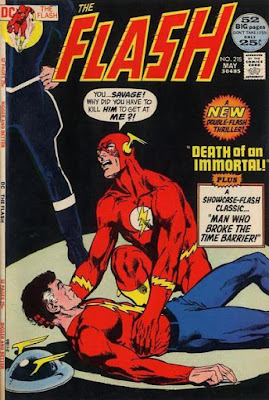
Speaking of the JSA, another story that resonates with me to this day is Flash #215, written by Wein during his short stint on that title, which I've briefly talked about before. With a dramatic Neal Adams cover and interiors by Irv Novick, in my opinion, the Flash artist, this story told the tale of Barry Allen waking up in bed with his Earth-Two counterpart's wife Joan, finding that he'd replaced Jay Garrick. After that weirdness, Barry goes on the find Jay in the limbo dimension and fighting the Vandal Savage, yet another Golden Age character that Wein breathed new life into. This remains one of my favorite Flash stories, and made me love Jay Garrick.

Also notable from this era were his Adventure Comics stories with Supergirl and Zatanna respectively, which I still love. I bet if he'd stayed on JLoA longer, he would have brought Zatanna on to the team much earlier than she ended up joining. While they were going on at roughly the same time, and I did not read them at the time, I did eventually read Wein's fantastic stories of the Swamp Thing, Phantom Stranger, and Korak, and dug them. And let's not forget that he also co-created the Human Target, a back-up feature I never understood as a kid, but loved as an adult.

This was the mid-1970s now, and Len Wein had moved across the street to Marvel Comics, where he would create Wolverine as a Hulk foe; assemble the New X-Men, reviving that title which had been in low-selling reprints for a while; and had longer (if not as memorable, to me at least) runs on titles like Amazing Spider-Man, Thor, Fantastic Four, and Marvel Team-Up. What I do remember him on was Defenders, which he picked up on after Steve Englehart left the book. Wein would recruit Nighthawk to the team, one of my favorite Defenders, after an eerily familiar clash with Marvel's parallel universe evil Justice League, the Squadron Supreme (or was it Sinister? I always get confused).

Len Wein would return to DC Comics however as an editor. He was editing both Justice League of America and Flash ironically when I met him at a Creation convention around the time of those two titles' 200th and 300th landmark issues respectively. I told him how much I enjoyed his Justice League stories, but also expressed, perhaps too cockily, an opinion that the 200th issue shouldn't be so full of guest-stars as the 100th issue was. He took the left-handed compliment well, smiled, and said I would be pleased with Justice League of America #200. I was, the tale, which pitted the original members against all the later members of the team in a retelling and return to their origin, is not only one of my favorite stories, but also a lot of folks' too.

Later Wein would go on to edit Watchmen, write the new Blue Beetle series, and oversee the Who's Who project, all wonderful stuff. He continued to write and edit for years to come, including Batman, Wonder Woman, and After Watchmen. He won many awards, even wrote for television animation, the last work I saw from him was the adaptation of Harlan Ellison's script for Two-Face on the 1966 "Batman" television series. We have lost one of the greats in the comics field, and we are all poorer for it. Len Wein was and is a legend, and he'll be missed.

Monday, July 03, 2017

Pirates of the Caribbean, Again?

Pirates of the Caribbean: Dead Men Tell No Tales ~ How many of these things are there? I understand the desire to move away from numbers in franchise titles as the Marvel movies do, and decades before with James Bond and Godzilla, but here with the Pirates movies I can't tell one from another, and it hurts my desire to see them, as I might get the continuity mixed up. I don't even know if this is movie number four, five, or six. Shouldn't that (and I'm not the only one with these questions) bother the folks in charge?

Of course the idea that Johnny Depp's Captain Jack Sparrow has rarely been either protagonist or antagonist in these films makes the storytelling difficult and therefore the continuity hard to follow. And Depp is no longer the sweetheart, matinee idol, and box office draw he used to be, so it might be advantageous for the studio to make some definitive decisions about this franchise, or just end it.

This one is set several years after the last one, whichever one that was, and still revolves around Captain Jack Sparrow. This time his compass unlocks the curse of the Devil's Triangle, and the Flying Dutchman, and the Trident of Poseidon, and whatever other kitchen sink mumbo jumbo McGuffins were needed for this mess of a movie. But honestly that's not fair, it's only Depp that makes the film unwatchable.

They try very hard to make a good movie, with a convincing plot, and believable performances, and stunning special effects - but every moment that Johnny Depp is onscreen it becomes a politically incorrect cartoon, that after a while, becomes frankly insulting. The character is annoying, sexist, and takes the focus off the story and the rest of the cast. Disney is removing the 'we wants the redhead' sequence from their Pirates ride, how about getting rid of the alcoholic misogynist Captain Jack as well?

As I said, the effects of the ghosts of the Triangle are quite amazing, and so are the undead sharks, even though I am so sure there was a board meeting where someone stood up and said two words with a grin on their face, "zombie sharks," and immediately got this flick greenlighted. All that aside, the undead sharks are freaking cool.

The Paul McCartney cameo where he sings "Maggie Mae" seemed way out of place, but I'm glad they got it over early and quick. Geoffrey Rush, Kaya Scodelario, and Javier Bardem were terrific when not being upstaged by Depp, but the real stars here are the effects and the event status of the flick. Blink and you're miss Paul McCartney singing "Maggie Mae." Attempts are made to tie up many of the loose ends from the previous three or four movies, but don't forget to stay for the after-credits scene that hints at a certain villain's return.

All in all, this was a bit too long, but was entertaining, and would have been a lot better without Johnny Depp. His time in the spotlight has long ago moved on.

Tuesday, May 09, 2017

What Hydra Really Is

Those of you who follow my work know how I feel about the current comics situation with Captain America and Secret Empire. If you don't, my thoughts on Captain America as a Hydra agent can be found here, here, here, here, here, and here, and the new crossover event Secret Empire here and here. Suffice it to say, reality was warped and Captain America is, and always has been an agent of Hydra, and in Secret Empire he makes his move as a major super-villain and takes over the planet in the name of Hydra.

Much has been made of what Hydra is and isn't, with many folks equating this organization with the Third Reich and Nazism. When the group was created by Stan Lee and Jack Kirby for Strange Tales #135 in 1965, they were essentially a modern day group of adversaries designed for Captain America who could take the place of the Nazis he routinely trounced in World War II.

Later, in a series by Jonathan Hickman that retconned much of S.H.I.E.L.D.'s history as well as that of Hydra, the organization was described as ancient, East Asian, and having origins going back centuries before the Third Reich. Those of you who have watched "Marvel's Agents of S.H.I.E.L.D." are aware of this retcon when the team fought the extraterrestrial creature called Hive. Hydra moved even farther from its Nazi origins when the Marvel Cinematic Universe made a point of referring to them as the science branch of the Third Reich which broke off into its own thing.

But even if you want to play this retroactive continuity game, here are the facts. Baron Zemo, Arnim Zola, Baron Von Strucker, and the Red Skull were all Nazis. They are all fascists, anti-Semites, genocidal maniacs, bent on world domination. They have all worn swastikas. Is it a coincidence they are also all founders of Hydra? If it quacks like a duck, folks...

So, anyone who knows what a metaphor knows what I'm talking about. Hydra equals Nazis, no matter what anyone says, and Marvel should be ashamed to have their symbol of freedom, the superheroic icon who began his career by punching Hitler in the mouth, become one of them. His creators Joe Simon and Jack Kirby would be sick over this, and Marvel should do what is right - apologize, and sweep this whole demented Secret Empire concept away and forget it ever happened. And pray that your readers forget it ever happened.

Friday, February 03, 2017

Daredevil S02 E09: Seven Minutes in Heaven

In the last episode of "Daredevil," we witnessed several revelations, not the least of which was the Punisher's cliffhanger meeting with the Kingpin.  One of the others was just more disturbing than dramatic.  After fighting to release Elektra from under Stick's wing, Matt finally sees her true nature - she's a sociopathic killer.  Love can't change that kind of stuff usually, at least not in the rough and tumble soap opera world of superheroics. 

As we open, it appears this opening sequence at least will go in a different direction, picking up from the end of last season with the incarceration of Vincent D'onofrio's Wilson Fisk.  He is advised by his lawyer to keep quiet, keep his head down, and remembering his performance last season, that's D'onofrio's golden range, silent and menacing. 

When challenged and warned by the 'kingpin' of the prison, an inmate named Dutton played by perennial bad guy William Forsythe, Fisk's instincts kick in and he attempts a coup.  He moves all of his last resources to gain an inside posse, bribe guards, and eventually bring the Punisher to him - bringing us up to date with the criminal mastermind.

Whether it's true or not, Fisk intimates to Frank Castle that Dutton orchestrated the murder of his family, and offers him a chance at closure.  Of course such a thing would benefit Fisk.  Kingpin plays the Punisher like a harp, and although Frank does get in one shot, calling him a 'has-been mob boss,' Fisk is clearly in control here. 

Meanwhile, Matt is busy breaking up.  First there was Karen, who over the last two episodes he subtly and indirectly kicked to the curb in unloving and uncaring fashion.  Now, after fighting for her freedom from Stick, he changes his mind as an afterthought and can't handle her being a sociopath who enjoys killing.  Seriously, this is the first time he's noticed that quirk??

So it's no surprise when Matt breaks up with Foggy too, not caring about either the friendship or the law firm.  Sure, we're watching from the omnipotent outside, but hasn't it occurred to anyone what Matt is really doing?  He's cutting people he cares about out of life, like someone preparing to commit suicide.  Does he really consider going after The Hand a suicide mission? 

Karen, with the law firm in limbo, is becoming more and more involved with the New York Bulletin, Ben Urich's old stomping grounds since Netflix can't use the Daily Bugle.  Her investigative skills have won her the attention of Ben's old editor, Michael Ellison, and he's looking to groom her for a job.  She's that good, but I miss Ben.  Great actor, great character, unnecessary death. 

After a trip to see the medical examiner whose testimony was trashed by Elektra, some pieces start to come together.  Ellison offers up Ben's old office for Karen to work in.  Seriously, it's been untouched for how long?  And how old is that bottle of Pepto-Bismol??  On the desk there's a file on Karen. Last season there was some hint of a dark secret in her past.  In the comics, her father was the super-villain Death's-Head, but here it appears she may have accidentally killed her brother. 

In prison, the Punisher gets his seven free minutes, referencing the episode title with demented glee, with Dutton.  Before Castle mortally wounds him, Dutton tells him of another player who was pulling the strings the day his family were killed - someone called the Blacksmith.  Now there is a Marvel villain called Blacksmith, but he's Skrull, and I really doubt that's where this is going. 

After Dutton, Fisk covers his ass and tries to have the Punisher killed by opening all of the cells in Dutton's block.  It's a free-for-all to kill Castle. Much like last season's hallway fight and the stair fight earlier this season, and even the arrow in the chest combat last episode, it seems like the show wants to keep one-upping itself in fight sequences.  The Punisher taking on and beating a dozen or so inmates is a good attempt. 

Of course when Frank is brought before Fisk later, there's another beatdown that the Punisher is not on the easy end of.  I was never fond of the Kingpin/Daredevil matching as I always considered Kingpin a Spider-Man villain, at least originally, but based on the performances in this episode, I could dig Fisk as a Punisher foe, maybe in the spin-off series? 

The Kingpin decides that the Punisher would be of more use to him on the outside than on the inside, and arranges for Castle to walk free.  That can't be good.  We close on Fisk, hospital bedside with Dutton, eating his dinner, waiting for him to drown in his own blood.  Chilling. 

In the background of everything else, Daredevil makes a strike on The Farm, a Hand facility.  There he finds children in cages with their blood being pumped from them.  It's pretty horrific.  There's also a ninja who nearly beats Daredevil to death.  As he escapes with a pod, possibly containing Black Sky, he unmasks.  It's Nobu Yoshioka

Daredevil gasps, as do the viewers, "you're dead!"  To which Nobu simply states, "There's no such thing," and disappears into a downward elevator. Cue closing credits.  Well, Stick did say they'd discovered the secret of immortality.  How can Matt stop The Hand, when he can't even beat one of their ninjas?  With Matt alone, and Elektra, the Punisher, and Nobu all on the loose, these last four episodes should be interesting...

Next: The Man in the Box!

Thursday, January 19, 2017

Daredevil S02 E08: Guilty as Sin

In the last episode of "Daredevil," the Punisher went to trial, from which Matt was absent, Elektra tampered with a witness, and Foggy and Matt had it out finally.  Oh yeah, and Daredevil and Elektra discovered the Yakuza guarding a seemingly mysterious bottomless hole about forty stories deep.  As we open, they're beset by ninjas, and this is only the beginning. 

Just before the ninjas nearly take them out, Daredevil and Elektra are rescued by Stick.  Cue opening credits.  As they try to escape by car, wave after wave of ninjas attack.  This is, no doubt, The Hand.  Badly wounded, they go to Matt's apartment where Stick does some wacky holistic voodoo on Elektra to save her.  Then the revelation comes that not only does Stick know her, he trained her. 

Obviously, Matt doesn't show up for the trial the next day as Frank Castle's former commanding officer takes the stand.  Colonel Schoonover is played by perennial heavy Clancy Brown, formerly The Kurgan, the voice of Lex Luthor, and most recently General Wade Eiling on "The Flash."  He tells a gripping tale of Castle's heroism on the battlefield, adding more pieces to the secret origin of the Punisher. 

While The Kurgan weaves war stories, Stick tells a tale of a different war, an ancient one involving The Hand.  These 'pieces of shit,' as Scott Glenn's Stick calls them, learned the secret of immortality in ancient times and used it to run rampant over much of Asia and the rest of the world.  They seek power and weapons, specifically something called Black Sky, which Daredevil ran across last season in the form of a child. 

The Hand has only one enemy, The Chaste, those warriors trained by Stick to oppose them, to fight them without mercy.  And Elektra is one of them.  Hell's Kitchen is to be ground zero for the battle between The Hand and The Chaste.  Matt treats this tale as a fiction, a power fantasy of Stick's to excuse his homicidal sociopathic behavior.  Unfortunately it's all he's got right now. 

Sigh.  This isn't the Daredevil series I want.  Yeah, it's good, very good, but rather than the Punisher, and Elektra, and The Hand, I think I'd rather have Gladiator, the Owl, the Stilt-Man, hell, even the Jester.  I guess I'm too old school for this stuff.  If they wanted to do a Punisher series (which is already on the schedule) or an Elektra series, why didn't they just do it? 

Frank Castle meanwhile is going to take the stand, supposedly in his defense.  Knowing they will need Matt to question him, Foggy sends Karen (perhaps deliberately?) to tell Matt.  She does, and gets a full view of not only crazy old blind man Stick, but also the dying/recovering Elektra in Matt's bed.  Kiss that relationship goodbye. 

In court, Matt makes a good case for both a mentally ill Frank Castle and the Punisher as the kind of hero we need, and then Frank starts talking, seemingly prodded by a guard.  Screaming that he's guilty, that everyone he killed deserved to die, and that he'd do it again - Frank effectively buries anything his defense was trying to accomplish. 

Back home, Matt throws Stick out after convincing Elektra to stay with him, and stop killing.  As soon as Stick makes his exit, a ninja of The Hand attacks and puts an arrow in Matt's chest.  Despite this obstacle, Matt and wounded Elektra finally subdue him.  The arrow made this fight for me, another wonderfully choreographed combat. 

And then Elektra kills him.  Just because she can, or wants to.  Elektra has a problem, a bad habit.  It would almost be funny if it wasn't so serious.  She's a killer, a sociopath, a psychopath.  All Stick did was channel her sick energy toward his goals.  I doubt Matt can do the same.

The mic drop of the episode is at the end where the suspicious guard takes Frank Castle through the prison to a gym area occupied by one man.  He turns around and we see him - Vincent D'onofrio as Wilson Fisk, the Kingpin, mentioned several times but unseen since the season one finale.  Cue end credits.  Now this should make things interesting. 

I'm ambivalent about the return of D'onofrio and Fisk.  While admittedly one of the most interesting characters and intense performances of the Marvel Netflix Universe, I would like to think his arc is done.  This is television, not comics where villains return every two months.  Still, I'm game to see what happens. 

Next: Seven Minutes in Heaven!

Tuesday, January 17, 2017

Daredevil S02 E07: Semper Fidelis

The trial of the People of New York v. Frank Castle is on, and we open the pre-credit sequence with jury selection. It's hard, because everyone has an opinion on Frank Castle, many of them both mirroring and polarizing my own, but as the judge so succinctly says, "This is New York, everyone has an opinion about everything." Let the trial begin.

So, courtroom drama. This is kinda what I have always hoped "Daredevil" would not be about. I know that lawyer shows are popular, always have been, but despite Matt Murdock's calling, this is a superhero show. I want to see superhero stuff. Yes, it is intriguing to put the Punisher on trial, but come on, less suits and more tights please.

I shouldn't really worry however, as the dry lawyer stuff is counterbalanced by Matt playing hooky with Elektra. As with their relationship a decade before, now she is still exerting a bad influence on our horned hero. What is done to the professor who translates the Roxxon ledger is not much better than what the bad guys might have done. Daredevil and Elektra might as well have been mob enforcers.

Later when they pursue a shipment learned of from the ledger, the violence is extreme. It is almost as if Daredevil doesn't care how he's hurting his opponents and that Elektra has forgotten her promise not to kill. I enjoyed the scar discussion and was glad it didn't go where I thought it would, you know, Jaws territory. It was actually more like foreplay with no pay off.

Of course Matt's late night shenanigans with Elektra make him late for the opening remarks in the Punisher trial. Foggy has to step in, and as Elden Henson has throughout this series, supports the more powerful players. Where's his Emmy? When Elektra doesn't like being sidelined by Matt's day job, she tampers with a witness, bringing the brewing hostility between Matt and Foggy to a head.

The fight between Foggy and Matt is intense, and has been simmering since this show started. Now it threatens Matt's relationship with Karen. Matt brings all this anger to Elektra as Daredevil, and to the pseudo-Yakuza. As if to divert our attention from the emotional drama going on, Daredevil and Elektra discover the Yakuza are guarding a hole, with no bottom. Cue end credits.

Not my favorite episode, more of a placeholder really, the bane of binge-watching, but at least the story moved, character was revealed, and significant stuff happened. I just wanted more from it.

Next: Guilty as Sin!

Tuesday, January 10, 2017

Daredevil S02 E05: Kinbaku

At the end of the last episode of "Daredevil," the Punisher had been apprehended and Elektra had made her first appearance, however momentary, in the series. Like it or not, we probably haven't seen the last of either of them.

Now as one of the few people on Earth who actually liked the 2003 movie and Jennifer Garner as Elektra (heck, comics continuity aside, I even thought her solo film was kinda fun in a wacky way), I have to confess, that much like the Punisher, I don't like the comics character.

In my opinion Frank Miller's work at both DC Comics with The Dark Knight Returns, and at Marvel Comics with Daredevil and the Elektra saga brought on a dark age of grim and gritty violence that comics still haven't recovered from. I respect the genius of the work itself, but the bleed over into the rest of the industry is simply tragic. This type of garbage still resonates, not just in the comics, but the films based on those characters as well. Superman should not be grim and gritty, case in point: Man of Steel and Batman v Superman: Dawn of Justice. Seriously, wtf? So there's that, I'm not a fan of Elektra.

"Kinbaku" opens ten years ago as Matt and Foggy try to crash a high class party. When Elektra catches Matt's attention and saves him from being ejected from the party, it is a beautifully framed moment, with bracelets clacking and sound vibrating from fingers on wine glass rim. Props go to Floria Sigismondi, a photographer and music video director, perhaps best known for The Runaways, who directed this episode.

After the title sequence however we are jolted back to reality, and the present, with Elektra's comment that Matt's German beer tastes like piss. Quite a contrast. Elektra Natchios is played by Elodie Yung, whose willowy body and proper British accent take a moment to get used to in the role.

Elektra is back in town for Matt's legal help, and perhaps to rekindle their old romance. Matt is having none of it, even when she goes into an extended exposition on the Roxxon Corporation. She has a business meeting with them and wants his expertise. She makes it seem innocent but also seems game for playtime as well. Matt gives the impression that their time together was a mistake he doesn't want to step in again. All things considered, she's exactly the kind of personality who would make s good assassin.

Back at work, the subplot ruse of Matt being an alcoholic to explain his disappearances is getting old. Speaking of old, Karen seems to be still obsessed with the Punisher, the authorities are keeping things covered up about him. Reyes wants all of the firm's files on the Punisher. And then there's that kiss between Karen and Matt. Oh, the webs we weave.

I loved the Indian restaurant where Matt and Karen's date eventually ends up. So cool with all the neon chili peppers, I'd like to eat there. It's just too bad that the date is colored by both Karen's obsession with the Punisher and Matt's obsession with Elektra. Any goodness there could be is ruined by subtext. As in the comics, I think this relationship is surely doomed before it even begins.

The story jumps back and forth between the decade ago flashback and now, telling the tale of Matt and Elektra. The fight/sex scene in the boxing ring after Elektra suspects Matt isn't blind is so well done, cray-cray, and reminiscent of the playground duel/foreplay scene in the 2003 movie. And of course as the episode goes on we learn what a dangerous sociopath she can be.

We see another date, this time in the home of Roscoe Sweeney, the man who long ago killed Matt's father. Perhaps it's time to discuss the title of the episode. Kinbaku is a particularly tight and nasty type of Japanese bondage. It's not only how Elektra binds Sweeney in the flashback, but the kind of grip she seems to have on Matt, tight and nasty. She still has that grip, as she has brought the Yakuza to her penthouse, and Matt there as well. She knows he's Daredevil, and wants to play.

Next: Regrets Only!

Friday, November 11, 2016

Marvel's Doctor Strange

Marvel's Doctor Strange ~ I was first introduced to Doctor Strange during the Avengers/Defenders war in the early seventies as he was the leader of the latter superhero team. I knew he was Marvel's 'magic guy' and that he'd been around since the beginning of the Marvel Age and was created by Steve Ditko and Stan Lee, the same team that brought us Spider-Man originally, but little else.

While my impression was usually the Sal Buscema Defenders leader, as I grew older I started to read the Ditko stuff, and it was out there, very weird with outlandish villains and bizarre mindscapes. I never dreamed anything like it could be brought to the screen, and yet the previews seem to indicate it can be done. But then again, I never imagined we'd have an Avengers movie, let alone three - Marvel is just full of miracles.

Beware spoilers hereafter.

I am not a Cumberbitch. I'm comfortable enough with my sexuality that I'm not afraid to say when a man is attractive, but I have never understood what women and men see in Benedict Cumberbatch. I love "Sherlock," but he's so unlikable a character there, and let's face it, his Khan was one of the worst things about Star Trek Into Darkness. So I was not sold when I heard Cumberbatch was cast as Doctor Stephen Strange. He proved me wrong. After seeing the movie, I can't see anyone else in the role.

The story is thematically the same as the hero's first appearance from 1963's Strange Tales #110, which I had first read more than four decades ago in Stan Lee's Origins of Marvel Comics. Arrogant surgeon Stephen Strange gets in a car accident that damages his hands. Unable to continue as a surgeon, Strange searches the world for cure, eventually coming upon the Ancient One, who gives him a new vocation with magic. Long story short, of course.

All the elements are here, the desperation, the salvation, but a few things are turned on their head. I'll start with the good and move to the ugly. We get more insight on major Doctor Strange enemy Baron Mordo, fellow student of the mystic arts under the Ancient One. I really liked Chiwetel Ejiofor here, easily one of the best performances of the movie, especially as he changes in the space of the film, beginning as an ally then by the end credit sequence, more villain than the actual villain of this piece.

Let's talk about Mads Mikkelsen and the character he plays, Kaecillius. I realize now that Kaecillius is an old school Silver Age foe of Strange, although essentially a henchman of Mordo's, but until the movie I had no idea who he was, and had to look him up. Why was he chosen as our hero's first foe? I wouldn't normally mind such an unknown entity if the actor behind him was worthy, and he is - Mads is a major heavy with incredible talent, but they really do very little with him or Kaecillius here. It's all posturing and posing, no real depth. All we get is Mordo, and we really have to wait for the sequel to see his evil turn.

And then there's the Ancient One. I have nothing against Tilda Swinton or her performance, she's amazing, and funny, and ominous, and tragic. But she's white. It's her casting I still have a problem with. With Mordo, a black man was cast into the role of a white character to wonderfully add diversity to the painfully white Marvel Age of the early sixties. But the Ancient One is actually one of the few Asian characters in that same age, and the producers chose to cast a white woman in that role.

In old Hollywood, this was called whitewashing. Taking an Asian role and casting white actors to play Asian. Movies that I love, like The Mask of Fu Manchu, The Good Earth, and Mr. Wu, are stained by both this practice and the racial stereotypes depicted. Sidebar to the stereotypes, Wong, Doctor Strange's servant is treated well and as an equal if not a better to Strange in this film, gracefully and cheekily by Benedict Wong. Notably the character was also treated equally well in the often forgotten but quite good 1978 television movie/pilot of Dr. Strange. Back on point, which is worse, the color blind casting of Mordo, or the whitewashing of the Ancient One?

Rachel McAdams is merely a plot device in the film, who could have been more, but doesn't live up to potential. If they were going to use Night Nurse in this film, why not use Rosario Dawson from the Netflix Marvel Television Universe? But then again, I admit my bias toward her, but why create another Night Nurse character - isn't the comics continuity confusing enough? I would have rather had Clea, perhaps we'll get her in the sequel.

Strange's journey into the magic world is wonderfully depicted, I even dug the Inception-like special effects of turning one's surroundings into a weapon by altering its structure (up is down, shifting buildings, moving gravity, and Escher nightmares). This was one of the ways the film depicted magic, and it made the fight scenes phenomenal, something we'd never seen before. I liked that the Cloak of Levitation was like a wicked stepbrother to the Rug from Disney's Aladdin and seemed to have a fun sentience. And then there's the rings.

The concept that certain items are imbued with magic and aid in the casting of spells is a solid and revered concept. Much of the Doctor Strange comics mythos comes from this - the Cloak, the Eye, etc., and then there's the Sling Ring, created for this film. The Sling Ring helps to cast portals, and without it, a portal cannot be opened. It actually plays well in some of the fight scenes I mentioned. When Strange says, "Sling Ring, do your thing" at one point, it completely removed me from the film.

Back in the bad old days of the 1970s when there really wasn't all that much comic book superheroism on television, and what there was was changed or made silly, there was a Saturday morning cartoon called "Fred and Barney Meet the Thing." Yes, that Fred and Barney. One of the program's segments featured a teenaged Ben Grim who could transform into the Thing by bringing two rings together and saying, "Thing Ring, do your thing." It took a while to recover when that happened in the film.

While I wished that Dormammu had a bit more fire (less Zemo, more Dormammu), I loved his representation here, and even the uncredited fact Cumberbatch did his voice. The way Strange beats him is brilliant. Casting problems and Thing Rings aside, I really did enjoy this movie. Of course stay through the credits for the two extra scenes, one a set-up for Mordo, and the other a seemingly mismatched piece directed by James Gunn that prologues Thor: Ragnarok. Highly recommended, as are most of the Marvel films.